Pool Cover Buying Checklist: Purpose, Size and Installed Cost
Separate solar blankets from safety-cover systems, confirm pool versus cover dimensions, and compare complete installed offers with an original purpose-and-fit record.
On this page
- Short answer
- Purpose before size: decision diagram
- 1. Separate the three buying tasks
- 2. Resolve pool size versus cover size before ordering
- 3. Treat drainage and upkeep as part of the purchase
- 4. Keep safety documentation separate from a sales label
- What this checklist helps with—and what it cannot settle
- Two-offer purpose-and-fit record
Short answer
Choose the job before the cover size: evaporation control, seasonal debris management and a documented safety-cover system are not interchangeable purchases. Then get the exact model, dimension convention, site fit, drainage requirements and complete installed scope in writing. A pool-size label or the words “winter cover” are not sufficient evidence of fit or safety performance.
This is an original, research-based buying checklist, not a hands-on product test, safety certification or installation procedure. Sources were reviewed October 23, 2026. We have not obtained a quote for your pool or verified an offered product’s certification. No model is ranked as a winner.
Safety boundary: a solar blanket is not a safety cover. Never walk or play on a cover to test it. Covers do not replace adult supervision or other required barriers. Keep children away from the pool area during measuring, removal and installation; use a qualified pool professional for site assessment. This page does not supply anchor spacing, overlap dimensions, load tests or permission to remove an existing barrier.
Purpose before size: decision diagram
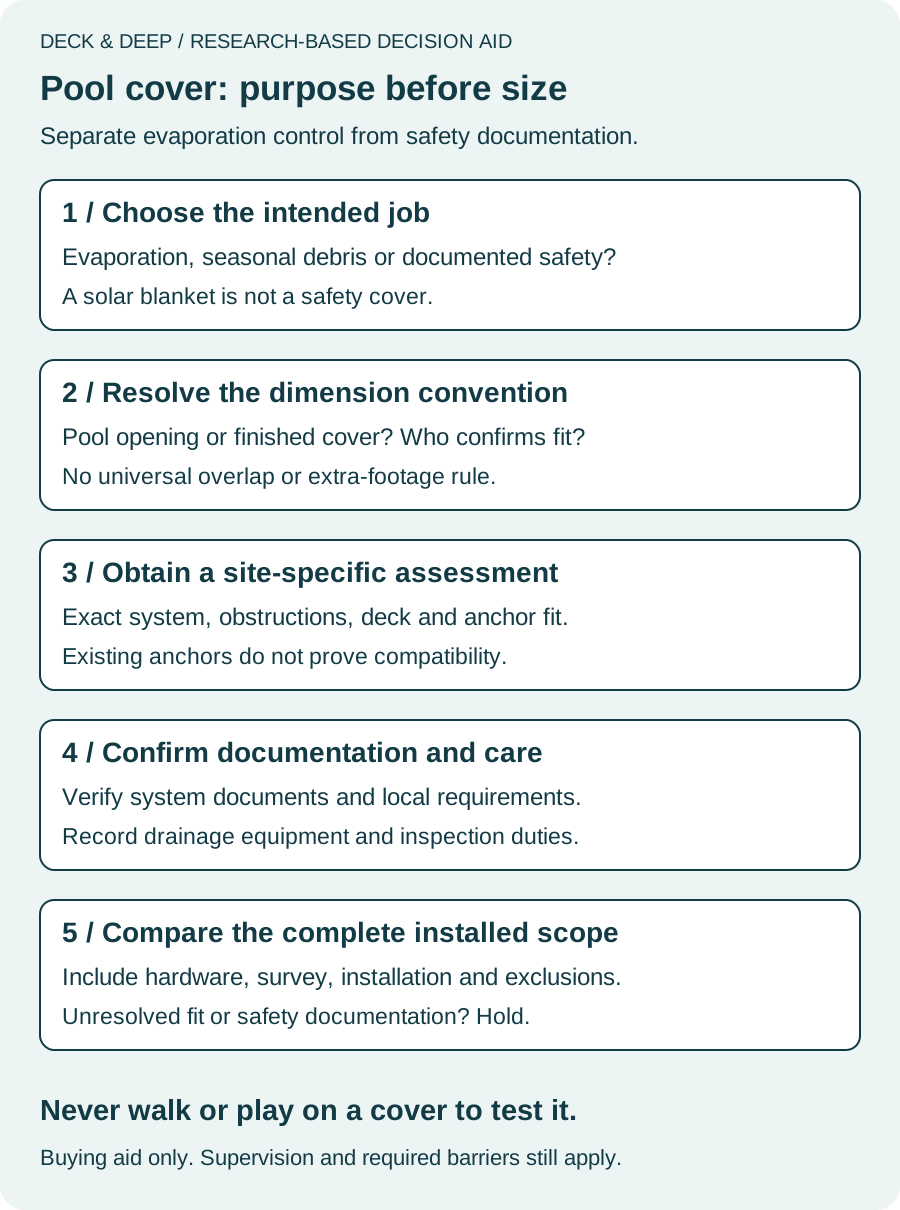
Decision diagram in words:
- Choose the job: distinguish evaporation control, seasonal debris management and a documented safety-cover system. A solar blanket is not a safety cover.
- Resolve dimensions: confirm whether the offer describes the pool opening or finished cover, what overlap is included and who signs off on fit. This is not a sizing formula; the current manufacturer measuring-form revision remains unverified here.
- Assess the site: have a qualified professional check the exact system against obstructions, deck condition and anchor or track requirements. Existing hardware does not establish compatibility.
- Verify documentation and care: obtain exact-system documents, confirm applicable local requirements and record drainage equipment, inspection duties and the unattended-period plan. The August 2012 CPSC booklet, archived October 2, 2026, is not current product approval or current-code verification.
- Compare complete offers: match installed scope, exclusions, warranty and custom-order terms. Hold the order while consequential fit or safety documentation remains unresolved.
This original research-based illustration is a purchase-planning aid, not a safety endorsement or installation procedure. Never walk or play on a cover to test it. Adult supervision and other required barriers remain necessary; the diagram does not authorize removal of any barrier.
1. Separate the three buying tasks
| Intended job | Evidence to request | What not to assume |
|---|---|---|
| Reduce evaporation and heat loss while the pool is not in use | Cover type, application/removal routine, storage and realistic use schedule | A bubble blanket is a safety barrier, or quoted savings will occur at your pool |
| Manage seasonal debris | Exact material, drainage configuration and off-season care instructions | Every product sold as a winter cover is a safety cover or protects plumbing from freezing |
| Add a documented safety-cover system | Exact-system documentation, required hardware, site-specific installation and local requirements | Material, marketing photographs or a generic standards claim prove the installed system is suitable |
The EPA guide, pages 2–4, explains evaporation and cover-use considerations. Its table explicitly distinguishes solar covers from safety covers. The table’s “can serve” category for solid/mesh/hybrid covers is not an endorsement of every product made from those materials.
EPA also emphasizes that evaporation reduction depends on applying the cover. A purchase that is impractical to remove, replace or store may not match the intended use schedule. Ask who will operate it and where it goes while people swim. Do not infer effort from material alone or buy on an unverified percentage-savings promise.
For heating decisions, carry the actual cover schedule into the heat-pump sizing and quote checklist. Keep seasonal cover selection separate from the equipment-specific freeze plan.
2. Resolve pool size versus cover size before ordering
Write down the seller’s meaning of the advertised dimensions. Are they the water opening, a nominal pool shape or the finished cover? Is overlap already allowed for? Who performs the final survey and accepts responsibility for the fit?
Do not add a generic number of feet to a pool measurement. Steps, raised spas, walls, rails and other obstructions need assessment for the exact product. The current official measuring-form revision was not verified for this guide; conflicting mirrored forms are not a sound basis for installation instructions. Request the applicable form from the manufacturer or installer.
An existing anchor pattern is useful information, not automatic compatibility. In its replacement-cover FAQ, LOOP-LOC describes matching existing anchor locations but adds that some cases require redrilling. That qualification belongs in the quote. Ask the installer to assess the deck, anchor condition and proposed system; do not drill, tension or improvise attachments from this article.
3. Treat drainage and upkeep as part of the purchase
“Solid” does not tell you whether the quoted configuration has drain panels or requires a pump. LOOP-LOC’s FAQ includes specific automatic-pump instructions for solid covers without drains. It warns that pool water can sometimes be pumped out and that excessive cover depression can stress the system. Those are reasons to request the actual manual and maintenance plan—not to borrow a water-level setting from another model.
Record the drainage equipment included in the price, suitable power provisions, inspection duties and arrangements when the pool is unattended. Have the installer explain the exact system’s water-level and winter-care requirements. Do not interpret marketing language as a maintenance-free promise.
LOOP-LOC also discourages walking or playing on its covers and calls for condition checks. Do not substitute a person, pet or heavy object for documentation of safety performance.
4. Keep safety documentation separate from a sales label
The CPSC’s Safety Barrier Guidelines for Residential Pools, Publication 362 (08/12), says on printed page 1 that barriers cannot replace adult supervision and advises checking local requirements. Printed page 4 describes barriers as layers of protection, not childproofing.
Source provenance: we read the complete October 2, 2026 archived copy of the CPSC booklet. Its publication date is August 2012, not 2026. Direct CPSC retrieval was blocked. We do not treat its historic standard references as verification of current code or a current product approval.
Ask for documentation for the exact cover system and the installer’s confirmation of site suitability. Verify applicable requirements with the local authority. Missing documentation is an unresolved purchase condition, not an approval. This checklist does not certify a cover, assess a child’s access routes or replace a site-specific safety review.
What this checklist helps with—and what it cannot settle
Useful for: separating cover purposes, requesting comparable installed scope, recording dimension conventions and identifying unresolved purchase conditions.
Limits: it cannot measure your pool, verify a product’s certification, approve existing anchors, establish current local compliance or forecast savings. The current manufacturer measuring-form revision remains unverified; the CPSC source below is an explicitly dated archive.
Two-offer purpose-and-fit record
Prefer paper? Use the one-page printable cover purpose-and-fit record to compare two offers and attach their supporting documents. It preserves unresolved measuring and safety-documentation gates; it is not a sizing formula or safety endorsement.
Copy these prompts for Offer A and Offer B. Leave unknowns marked unknown rather than treating blanks as included work or zero cost.
- Purpose and use: intended job, season, realistic cover schedule, who removes/replaces it and storage location.
- Exact product: manufacturer, model, material, configuration, seller, dated offer and applicable manual revision.
- Size convention: pool-opening versus finished-cover dimensions; included overlap; survey provider and written fit sign-off.
- Site assessment: shape, steps, raised features, obstructions, deck condition, anchors/tracks; existing hardware reuse confirmed or unresolved.
- Safety documentation: exact-system documentation, required components, installer assessment and applicable local requirements. No home load test.
- Drainage and care: panels/pump arrangement, included equipment, power provisions, inspection/water-level duties and unattended-period plan.
- Full installed scope: cover, hardware, custom treatments, survey, installation, drainage equipment, electrical work, delivery, tax and exclusions. Record quoted amounts; do not invent allowances.
- Contract and decision: warranty/exclusions, custom-order return rules, open questions and person responsible for resolving each before approval.
Order hold: do not approve a custom purchase while consequential dimensions, site suitability, safety documentation or excluded work remain unresolved. LOOP-LOC’s FAQ says its custom covers cannot be returned or exchanged; do not generalize that policy to every seller, but obtain the actual contract before paying.
The cheapest cover-only line is not necessarily the lowest complete installed offer. Compare matching scope first. This record contains no price estimate, savings forecast or affiliate enrollment claim.
FAQ
Is a solar pool cover a safety cover?
No. EPA's pool water-efficiency guide lists solar bubble covers, solar rings and thermal covers as not safety covers. Do not treat evaporation control as protection against access to the water. Keep adult supervision and other required barriers in place.
How much bigger than my pool should the cover be?
There is no universal extra-footage rule in this guide. Have the seller state whether the listed size describes the pool opening or finished cover, what overlap is already included, and who approves final measurements for the exact system.
Can a replacement safety cover use existing anchors?
Do not assume it can. LOOP-LOC's replacement FAQ says existing anchor locations can be matched but also notes that some cases require redrilling. Obtain an assessment and written confirmation for the actual cover and site before ordering.
Does a solid cover always need a cover pump?
Drainage depends on the exact configuration. LOOP-LOC publishes pump instructions for solid covers without drain panels. Confirm drainage, included equipment and maintenance responsibilities from the offered system's manual rather than inferring them from the word solid.
Will a pool cover guarantee lower heating bills?
No individual savings guarantee follows from the sources here. EPA explains that covers reduce evaporation when applied; actual use, climate and heated-pool conditions matter. Keep a seller's savings estimate and its assumptions separate from the installed price.
Sources
Manufacturer pages, manuals and warranty documents we read for this guide. Specs and terms change; we re-check them on the "last checked" date above.