Pool Heat Pumps in Texas: Sizing, Running Cost and the Quote Checklist
Choose a pool heat pump around your swimming schedule, cool-weather output and installed cost—not gallons alone. Includes a worked energy example and quote worksheet.
On this page
- Short answer
- Start with the swimming plan, not a product ranking
- Purchase decision diagram
- Texas is not a single sizing condition
- The sizing brief to hand your installer
- Estimate operating cost without confusing output and input
- Compare the installed job, not just the equipment price
- Where this approach fits—and where to pause
- Copyable purchase decision card
Short answer
Choose a Texas pool heat pump for your swimming schedule and site conditions, not just the gallon number on a listing. A unit that maintains a covered pool during mild weather is not automatically the right choice for rapid spa heating or a cold-weather swim deadline. Get an exact-model sizing assessment and a complete installed quote before ordering.
This is a research-based planning guide, not a hands-on test or a ranked list of “best” heaters. The manufacturer evidence below comes from Pentair’s UltraTemp installation and user guide, retrieved October 21, 2026. Its model-family instructions illustrate the questions to ask; they do not establish specifications for another brand or a different manual revision. We have not obtained installation quotes for your property.
Start with the swimming plan, not a product ranking
| Your actual goal | What to request before buying |
|---|---|
| Maintain a comfortable temperature through selected swimming months | A site-specific heat-loss assessment, operating schedule and cover assumptions |
| Heat a cold pool for a particular weekend | A written warm-up estimate at your expected air and starting-water conditions |
| Heat a spa quickly on demand | A comparison of suitable heater options and recovery times, not just maximum water temperature |
| Swim during cold spells | Low-temperature output, efficiency, operating limits and defrost behavior for the exact model |
| Cool an overheated pool too | Written confirmation that the specific model supports cooling; do not infer this from the product-family name |
In English page 1, Pentair explains that heat pumps transfer heat from surrounding air into pool water. It describes UltraTemp as better suited to maintaining a set temperature than fast heating, and warns that warming a cooled pool can take days depending on conditions. That is a reason to define the job before comparing equipment—not a promise that every pool takes the same time.
Purchase decision diagram
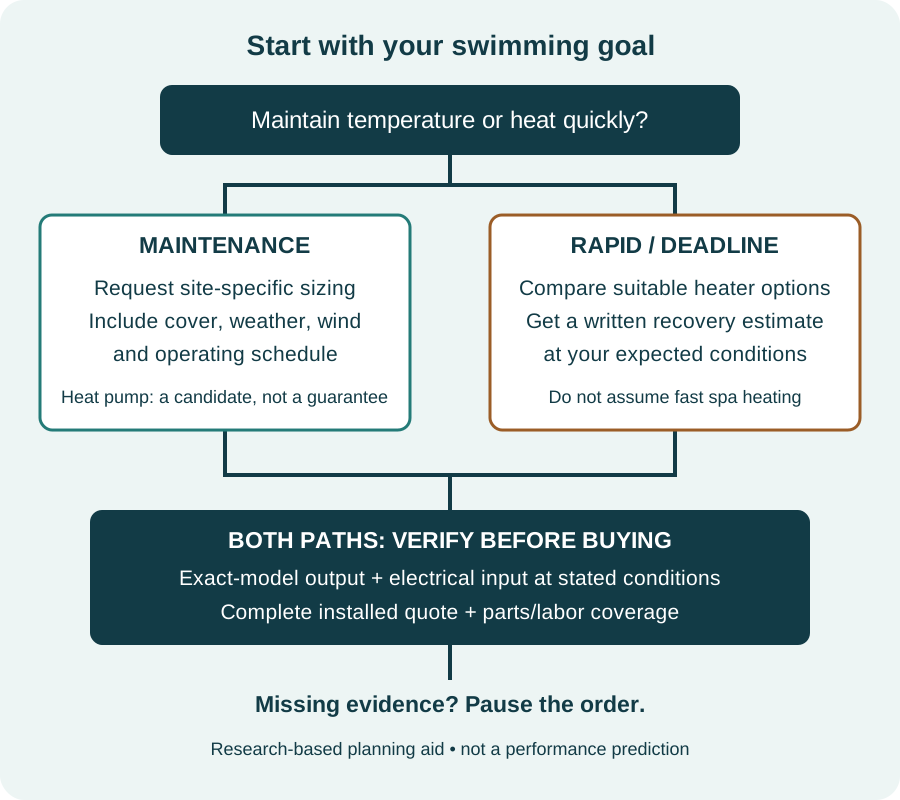
Text version of the decision diagram
- Maintaining temperature? Request site-specific sizing that includes cover use, weather, wind exposure and operating schedule. A heat pump is a candidate to assess, not a guaranteed fit.
- Rapid spa heating or a fixed swim deadline? Compare suitable heater options and get a written recovery estimate at your expected conditions. Do not assume a heat pump provides fast recovery.
- For either path: require exact-model heating output and electrical input at stated conditions, a complete installed quote, and parts/labor coverage. Missing evidence means pause the order—not guess a size.
Use the installer sizing brief and purchase decision card below to turn either path into a comparable quote.
Texas is not a single sizing condition
Do not substitute “Texas weather” for the conditions at your pool during the months and hours you plan to heat. Have the installer record the local design conditions used in the quote. A monthly daytime average alone does not describe a cold night or a windy swimming area.
Pentair’s page 1 discussion uses 80°F air, 80% relative humidity and 80°F water as ideal/rated conditions. Page 22 describes possible defrost around 50°F air temperature, with efficiency decreasing as air temperature falls. These are UltraTemp manual statements, not a universal 50°F shutoff rule, a statewide climate forecast or evidence that every heat pump has identical behavior.
Ask for output and efficiency at the same air, water and humidity conditions when comparing two models. A large warm-weather BTU/h number is not proof of the output available on your intended swimming day. If the provider cannot supply relevant performance data, keep the sizing decision open rather than filling the gap with a guessed percentage reduction.
The sizing brief to hand your installer
Record these inputs before collecting quotes:
- Pool surface dimensions and shape, estimated gallons, and whether a spa is included.
- Desired water temperature, starting temperature and target swimming months.
- Whether you want continuous temperature maintenance or occasional warm-up, and how much advance notice is acceptable.
- Cover type and the hours it will actually be used. A plan that assumes nightly covering is not the same as an uncovered pool.
- Wind exposure, shade and the proposed equipment location.
- Existing circulation pump, filter, plumbing, controls and available electrical supply, assessed by qualified professionals.
Ask the provider to explain how those inputs support the proposed size. This guide deliberately does not give a “20,000 gallons = one heater size” rule. Volume matters for warm-up; it does not by itself establish heat loss or available heater output.
Pentair recommends a cover to reduce heat loss on page 16. Do not confuse a thermal cover with a certified safety cover or a substitute for required pool barriers. Cover suitability and safe use need their own assessment.
Estimate operating cost without confusing output and input
The heating-output rating is not the electricity draw. For a straightforward electricity estimate, use:
Daily heater electricity cost = electrical input (kW) × operating hours × electricity rate ($/kWh).
Use documented input power for the relevant operating condition or a suitable measured energy total. Do not open electrical equipment to measure it yourself. Breaker size is not a running-power measurement; rated heating output is not electrical input either.
Worked example—not a forecast
Assume a hypothetical heater draws 5 kW, operates 8 hours per day, and electricity costs $0.16/kWh:
- Electricity used: 5 × 8 = 40 kWh per day.
- Heater electricity cost: 40 × $0.16 = $6.40 per day.
- If that identical schedule repeated for 30 days: $192.
Those are chosen example inputs, not a product specification, Texas average, current tariff or guarantee of comfort. The calculation does not determine how many hours your pool requires. Cycling, weather and operating conditions can change energy use; use actual kWh when available. Include relevant variable electricity charges and time-of-use rates in your own calculation.
Add circulation without counting it twice
Pentair’s page 16 instructions require the pool pump to run with water flowing through the heater. If heating extends filtration hours, include that extra pump electricity. If you are calculating the entire equipment bill, count all circulation energy once. If you are comparing the incremental cost of adding heating, separate the circulation energy you would have used anyway.
Use our pool-pump energy cost calculator for the circulation component, with appropriate watts and hours. It is not a heat-loss model and does not predict heater runtime.
Compare the installed job, not just the equipment price
No statewide installation price is claimed here. Obtain itemized local quotes with matching scope:
| Quote item | Required clarification |
|---|---|
| Equipment | Exact model/SKU, heating-only versus heating/cooling, and the applicable manual |
| Performance | Output and electrical input at stated conditions; expected warm-up or temperature-maintenance plan |
| Electrical | Qualified electrician’s scope, supply assessment, required protection, grounding and bonding, and any upgrades |
| Site | Pad, manufacturer airflow clearances, drainage and service access |
| Hydraulics | Required flow range, existing pump capability, piping changes and any bypass requirements |
| Controls | Compatibility with the existing automation and who programs the operating schedule |
| Commissioning | Startup checks, operating instruction and documented settings |
| Warranty | Purchase-channel conditions, parts/labor coverage, registration and claim contact |
| Total | Taxes, delivery, permits where applicable, exclusions and quote expiration |
Pentair’s pages 1 and 9 require qualified installation and electrical work under applicable codes, including grounding and bonding. Do not assume an existing pump circuit can also serve the heater, and do not select a breaker or wire size from this article. Have the electrician use the exact unit’s instructions and local requirements. Plumbing, controls and airflow also need assessment; a physically convenient spot is not proof of a compliant installation.
Our online-equipment warranty guide explains why seller channel and installation conditions deserve separate checks. Its comparison matrix is not a heat-pump warranty table: obtain coverage for the exact heater you are considering.
Where this approach fits—and where to pause
A useful candidate when: you want to maintain temperature, can plan ahead for warm-up, and have a documented site assessment supporting the proposed model and operating cost.
Pause before buying when: rapid recovery is essential, relevant cold-weather performance is missing, or electrical and installation work have not been priced. A low equipment price does not resolve these gaps.
Copyable purchase decision card
Pool dimensions / estimated gallons: ______
Target water temperature / swimming months: ______
Maintenance versus occasional warm-up / acceptable wait: ______
Cover schedule / wind exposure: ______
Exact heater model and manual: ______
Output and electrical input at stated air/water/humidity conditions: ______
Proposed operating hours and basis for that estimate: ______
Electrical, hydraulic and controls work included: ______
Complete installed total / exclusions: ______
Parts and labor coverage / claim provider: ______
Ready to compare quotes: the site inputs, performance conditions, installation scope and coverage are documented. Not ready to order: the recommendation relies only on gallons, an unspecified “up to” rating or an equipment-only price with no installation assessment.
Finally, heating equipment is not a whole-system freeze-protection plan. Use the Texas pool freeze planning guide to separate normal operation, outages and professional restart checks.
FAQ
What size heat pump does a Texas pool need?
Gallons alone do not determine the right size. Give a qualified installer the pool dimensions, desired water temperature, swimming months, cover schedule, wind exposure and required warm-up time. Ask for the exact model's output at the conditions when you will use it, not just a warm-weather headline rating.
How much does a pool heat pump cost to run?
Use electrical input in kilowatts multiplied by operating hours and your electricity rate. A hypothetical 5 kW unit running eight hours at $0.16 per kWh costs $6.40 for that day, excluding circulation and other loads. That is an arithmetic example, not a Texas average or a forecast of the hours your pool needs.
Will a pool heat pump work in cold weather?
Output and efficiency depend on conditions and the exact model. Pentair's UltraTemp manual describes possible defrost around 50°F air temperature and reduced efficiency as air temperature falls. That is model-family guidance, not a universal cutoff or a promise of winter swimming.
Is a heat pump a good choice for fast spa heating?
Do not assume it is. Pentair describes UltraTemp heat pumps as suited to maintaining temperature rather than instant or fast heating. If fast recovery is essential, have an installer compare appropriate heater options and document the expected recovery time.
Can I connect a heat pump to the existing pool-pump circuit?
Do not assume the existing circuit is suitable. A qualified electrician must evaluate the exact equipment, supply, protection, grounding and bonding against the manufacturer instructions and applicable codes. This guide is not a wiring procedure.
Sources
Manufacturer pages, manuals and warranty documents we read for this guide. Specs and terms change; we re-check them on the "last checked" date above.