Clean or Replace Your Pool Filter Cartridge?
Separate cleaning triggers from replacement evidence. Compare model-specific instructions, pressure at matching RPM and condition with an original service record.
On this page
Short answer
A cleaning trigger is not automatically a replacement verdict. Start with the exact filter and cartridge instructions, a trustworthy new-element baseline and comparable observations after proper service. Damage, persistent restriction and shortening service intervals deserve assessment; age alone does not establish that every cartridge needs replacing.
This original, research-based guide helps document a buying decision. It is not a hands-on test, diagnosis, promised lifespan or cleaning procedure. Sources were checked October 23, 2026. If replacement is supported, our cartridge identification guide addresses which exact element and quantity to buy.
Safety boundary: never open a pressurized filter. Trapped pressure can cause violent component separation and serious injury or death. A zero gauge reading alone is not permission to open the vessel. Use accessible records and a qualified pool professional; inspect only an element already safely removed or the professional’s report. Do not continue operating unsafe equipment merely to complete this record. This page supplies no isolation, clamp, opening, chemical-cleaning or restart steps.
Clean, diagnose or replace: decision diagram
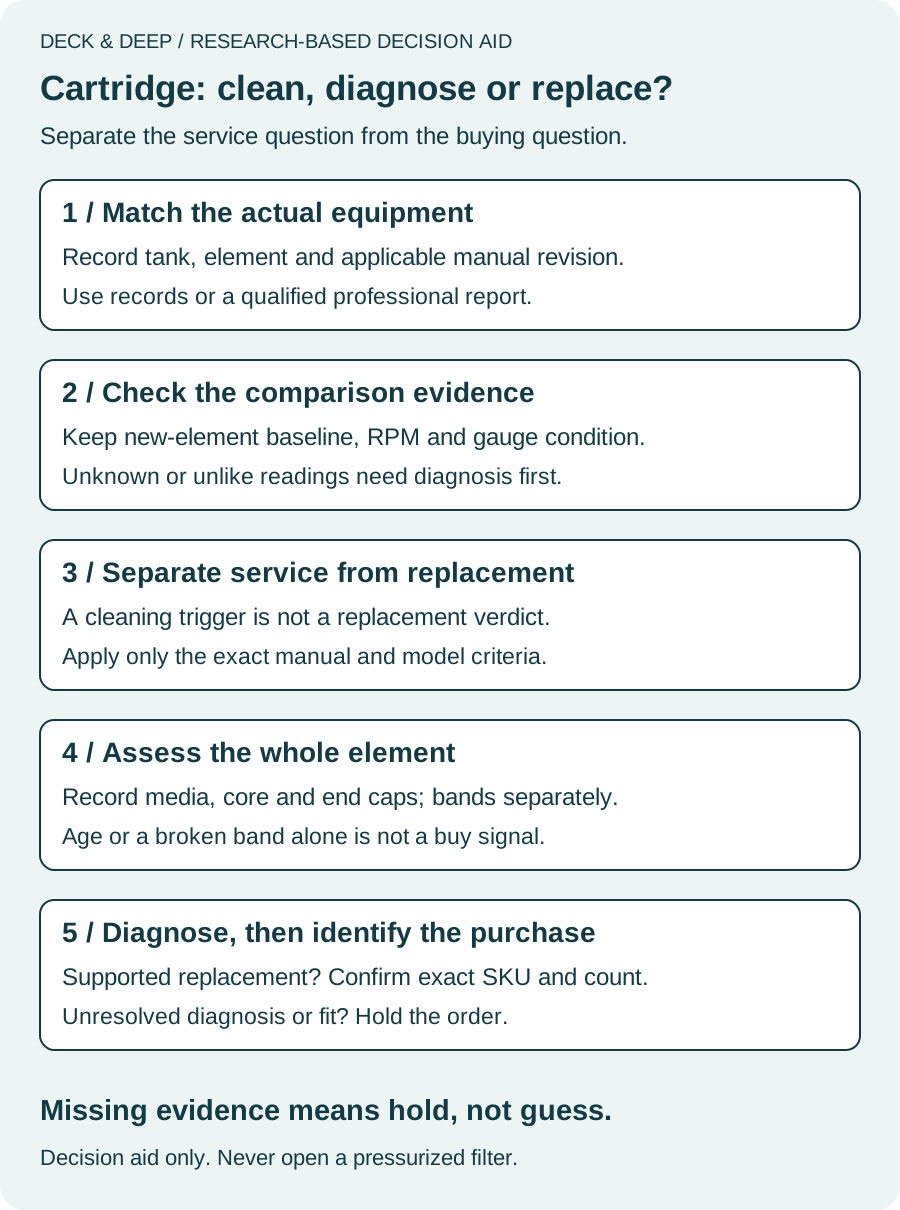
Decision diagram in words:
- Match the equipment: record the full tank and element identity and applicable manual revision. Use accessible records or a qualified professional’s report, not an improvised opening procedure.
- Validate the comparison: retain the original new-element baseline, pump RPM, relevant system conditions and gauge reliability. Missing or non-comparable evidence needs assessment; do not invent a baseline.
- Separate service from replacement: a cleaning trigger is not a replacement verdict. Use only the criteria and timing for the actual model and manual; the Hayward example below is not an immediate-replacement rule or a universal pressure threshold.
- Assess the whole element: record media, core and end-cap condition from a safely removed element or professional report. Keep band-only observations separate. Age, one shortened service interval or a broken band alone does not establish the need to buy.
- Diagnose before ordering: if the assessment supports replacement, confirm the exact SKU, compatibility and required quantity. Otherwise seek service or system diagnosis and hold an unresolved purchase. Replacement media is not a repair for unsafe equipment.
This original research-based illustration is a decision aid, not a cleaning, opening or restart procedure. Never open a pressurized filter. Do not operate unsafe equipment to finish the record. Filtration assessment does not certify swimming safety; all model-specific qualifications below remain in force.
1. Establish what the readings actually mean
Record the tank model, manual revision, element identifier and service history before comparing numbers. Keep the original new-element pressure separate from the pressure after cleaning an older element. An unknown original reading stays unknown—do not substitute a dirty reading or a value found online.
The Pentair Clean and Clear Plus 2025 manual, printed pages 1 and 6, records Original Starting Pressure and Original Pump RPM. It explains that starting pressure depends on pump speed. A before/after comparison without RPM and relevant system conditions can mislead. Record those conditions; do not change valves or equipment settings just to create a comparison for this article.
Its printed page 9 requires a functioning gauge and addresses damaged, unreadable or incorrect readings. An unreliable gauge is a service problem, not proof the cartridge is exhausted. A single tank-gauge reading also is not a direct measurement of inlet-to-outlet differential pressure.
2. Keep cleaning and replacement criteria separate
These examples show why a universal pressure rule is a poor buying shortcut. They apply only where the equipment and manual match. They are not operating limits or permission to delay service when equipment is unsafe.
| Source and scope | What the source says | What it does not establish |
|---|---|---|
| Pentair Clean and Clear Plus, 2025 guide, printed page 1 | Approximately 10 PSI above Original Starting Pressure or a significant reduction in flow is a cleaning trigger. | Automatic cartridge replacement or a threshold for every filter. |
| Hayward SwimClear ISC2031 REV B, C2030/C3030/C4030/C5030/C7030, printed page 5 | At a rise of 7–10 PSI over starting pressure, or flow below the desired rate, clean or replace the elements. | Which choice is justified solely from that one reading. |
| Same Hayward manual, printed page 6 | After cleaning and reinstallation, if starting pressure is higher than 6 PSI above the starting pressure with new elements, replace the elements the next time the gauge arrow reaches the red arrow. | “Replace immediately at 6 PSI,” a rule for all Hayward filters or permission to keep using damaged equipment. |
The official Hayward C4030 page linked the retrieved ISC2031 REV B manual. Its current linked PDF uses a booklet layout: printed pages 5 and 6 appear on PDF sheets 5 and 6, respectively. The cover names the five models above; this does not establish applicability to every unit with the SwimClear name. Confirm the actual model and revision with the service professional.
Pentair’s support page provides separate clamp manuals. Match the actual equipment, not just a familiar family name. The retrieved 2025 manual also contains “after backwashing” wording on printed page 7 that we have not resolved. We do not infer backwash capability or recommend backwashing from that wording.
3. Assess condition without inventing an expiry date
Unicel’s replacement guidance says cartridge elements do not have a defined termination point. Assuming proper maintenance and correct pump sizing, it identifies shortening intervals between cleanings, low flow with high differential pressure, and catastrophic failure such as torn media or a collapsed core as replacement evidence.
Those assumptions matter. A shorter interval after unusual debris loading or an algae cleanup is not, on its own, proof that the element has reached the end of its life. Document changed conditions and ask the professional to distinguish element condition from system or water-care problems. Cloudy water alone does not prove cartridge failure, and a replacement cartridge does not certify water safe for swimming.
Broken band versus damaged media
Unicel’s troubleshooting section says broken or missing spacing bands alone need not require replacement. Elsewhere on the same page it describes loose or missing bands as a possible wear indication, while saying split bands do not affect performance. The useful distinction is band-only observation versus the overall element condition—not “every broken band means buy” or “ignore all damage.”
Record media tears, core condition and end-cap damage separately, based on an already safely removed element or a professional report. Get element-specific guidance before deciding whether a band observation is isolated or accompanies meaningful deterioration.
Avoid a generic cleaning recipe
Hayward’s cited manual requires qualified professional service and prohibits pressure washing. Equipment and element makers can differ in cleaning guidance. This article does not combine their instructions into an acid-soak recipe or generic brushing recommendation. Ask the service provider to identify the method approved for both the actual equipment and element, and resolve conflicting instructions before proceeding.
4. Original before-and-after service record
Copy this record for the service discussion, or use the one-page printable before-and-after service record. Leave unknowns visible. Gathering evidence never takes priority over correcting unsafe equipment.
| Record field | Your evidence or answer |
|---|---|
| Tank maker, full model, revision and element identifier | Unknown |
| Applicable equipment/element instructions, URLs and pages | Unknown |
| Service date and qualified service provider | Unknown |
| Original new-element pressure, date, RPM and system configuration | Unknown |
| Gauge condition and reliability confirmed by whom | Unknown |
| Before-service pressure, RPM, observed flow and date | Unknown |
| Changed debris load, algae cleanup or equipment conditions | Unknown |
| Service performed, by whom and applicable instruction reference | Unknown |
| After-service pressure, RPM, observed flow and date | Unknown |
| Before/after conditions comparable, or reason not comparable | Unknown |
| Media, core and end-cap condition from safe inspection/report | Unknown |
| Band-only observations, recorded separately | Unknown |
| Dates and intervals between comparable services | Unknown |
| Exact manufacturer’s replacement criterion and professional assessment | Unknown |
| Decision: service review / system or gauge diagnosis / confirmed replacement / unresolved | Unresolved |
Stop at the unresolved item, not at a checkout page. If the baseline is missing, ask what evidence can support a decision for that specific system. If pressure stays high after service, request a diagnosis rather than assuming that either another cleaning or new cartridges must solve it.
5. Buy only after the diagnosis and identity agree
When replacement is supported, document the exact SKU, tank compatibility and required count. Use the identification guide and catalog-conflict example and its one-page purchase record. A single element’s price and a full set’s price are not comparable until quantity is confirmed.
Request a dated complete quote that separates elements, service, shipping, tax and exclusions. Do not calculate savings from an invented future lifespan. If the tank, clamp or other equipment needs attention, use the complete-filter replacement comparison rather than treating new media as a pressure-vessel repair.
Ready for a replacement quote: the service assessment supports replacement under the applicable instructions, and the exact tank, element and quantity are confirmed.
Hold the purchase: the gauge is unreliable, readings are not comparable, the baseline is missing or the diagnosis and part identity remain unresolved. A low price does not resolve those gaps.
The practical outcome is one documented decision: approved service, system diagnosis, confirmed replacement or a clearly stated hold. Filtration condition and water testing remain separate checks; neither a clean-looking cartridge nor clear-looking water establishes swimming safety.
FAQ
How often should I replace a pool filter cartridge?
There is no universal age cutoff established by the sources in this guide. Unicel describes condition and service-cycle evidence, assuming proper maintenance and correct sizing. Use the applicable equipment and cartridge instructions rather than a calendar alone.
Does high pressure after cleaning mean I need a new cartridge?
Not by itself. Check the gauge and whether the pressure readings reflect comparable pump RPM and system conditions. Then apply the exact manual's replacement criterion. A missing new-element baseline is unknown evidence, not permission to invent a value.
Does a broken cartridge support band require replacement?
Unicel says broken or missing bands alone need not require replacement, while also describing loose bands as a possible wear indication. Record the band separately from torn media, core or end-cap damage and seek guidance for the actual element.
Can I use this guide to open or acid-clean a filter?
No. This is a purchase-decision record, not an opening, chemical-cleaning or restart procedure. Use a qualified pool professional and the applicable equipment and element instructions. A zero gauge reading alone does not authorize opening a pressure vessel.
Sources
Manufacturer pages, manuals and warranty documents we read for this guide. Specs and terms change; we re-check them on the "last checked" date above.
- Unicel — Maintenance & FAQ, replacement and broken-band guidance (unicelfilters.com)
- Hayward — official C4030 product page and linked ISC2031RevB manual (hayward.com)
- Hayward — SwimClear ISC2031 REV B, printed pages 5–6 (booklet PDF) (commerce.hayward-pool-assets.com)
- Pentair — Clean and Clear Plus official product support and separate clamp manuals (pentair.com)
- Pentair — Clean and Clear Plus 2025 guide, printed pages 1, 6 and 9 (pentair.com)