Automatic Pool Cover Pump Buying Checklist: Fit Before Flow
Compare cover-pump compatibility, activation-depth documents, hose routes, electrical provisions and cold-weather limits with an original two-offer purchase record.
On this page
- Short answer
- Fit before flow: decision diagram
- 1. Confirm the cover needs this pump arrangement
- 2. Match switching depths to the actual documents
- 3. Compare a discharge route, not just headline GPH
- 4. Budget for suitable electrical provisions
- 5. Resolve inspection and cold-weather responsibilities
- What this checklist settles—and what it does not
- Two-offer compatibility and complete-cost record
Short answer
Buy a cover pump only after the cover, pump and discharge arrangement have been checked together. A headline gallons-per-hour rating does not settle cover compatibility, switching depth, outlet suitability or cold-weather use. Get the exact model and applicable manual first; hold the purchase when a consequential requirement remains unknown.
This original, research-based checklist uses manufacturer documents reviewed October 23, 2026. It is not a hands-on test, installation procedure or performance ranking. The two named models illustrate documentation questions—not recommended winners. Prices and complete warranty terms have not been audited here.
Safety boundary: never walk onto a cover to position or retrieve equipment. Do not handle powered equipment while standing in water or with wet hands. Keep children away from the work area and use qualified professionals for electrical work and site assessment. A cover pump is not a safety barrier, a pool-draining plan or permission to use a damaged cover.
Fit before flow: decision diagram
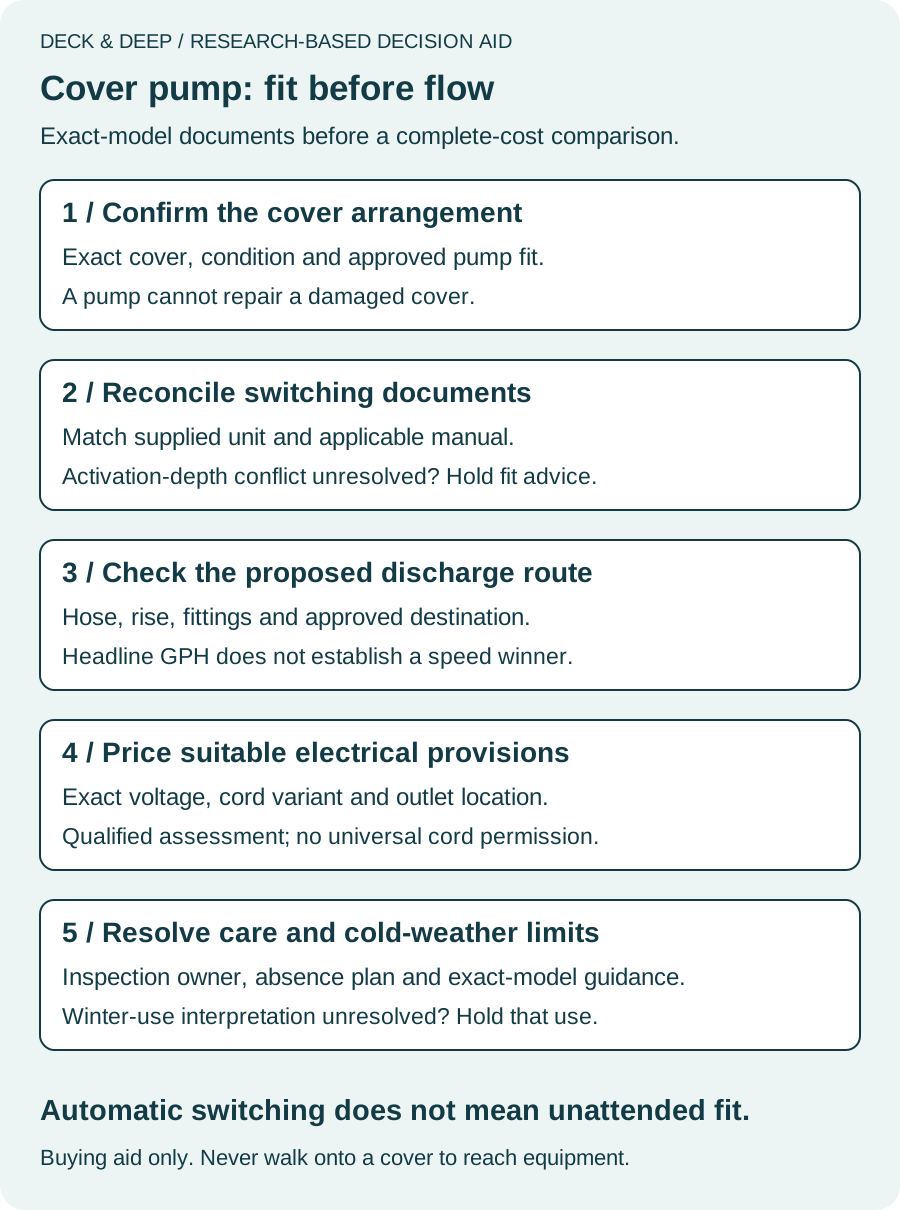
Decision diagram in words:
- Confirm the cover arrangement: identify the exact cover, its condition and the proposed pump’s compatibility. Obtain site assessment; a pump is not a repair for a damaged cover.
- Reconcile switching documents: match the supplied unit to its applicable manual and the cover’s water-management requirements. The Little Giant activation-depth conflict remains unresolved; minimum-depth fit advice stays withheld.
- Check the discharge route: record hose dimensions, vertical rise, fittings and destination approval. Headline GPH values do not establish a performance winner for that arrangement.
- Price suitable electrical provisions: have a qualified electrician assess the exact voltage/cord variant and outlet location. There is no universal extension-cord permission in this guide.
- Resolve care and cold-weather limits: name the inspection owner and absence plan, and obtain exact-model winter guidance. The Little Giant winter-use interpretation remains unresolved; do not treat this diagram as permission to leave a unit installed in freezing conditions.
This original research-based illustration is a purchase-planning aid, not an operating procedure or performance ranking. Automatic switching does not establish unattended suitability. Never walk onto a cover to position or retrieve equipment; hold the affected purchase or intended use until consequential unknowns are resolved.
1. Confirm the cover needs this pump arrangement
Start with the pool-cover purpose and fit checklist: drain-panel configurations and pump-dependent configurations are different purchases. Ask the cover manufacturer or installer to identify the drainage arrangement and approve the proposed pump for that exact system.
Record the cover’s model and condition, required water-management limits and how the pump will be positioned and retrieved safely. The WAYNE manual, pages 3 and 6, warns about weak, damaged or leaking covers and the possibility of removing treated pool water. A pump is not a repair for those conditions. Stop and have the cover assessed rather than trying to solve unexplained water loss with a larger pump.
2. Match switching depths to the actual documents
Automatic switching responds to the pump’s detection mechanism. It does not establish a safe standing-water level for every cover. Have the cover provider and pump manufacturer reconcile the applicable limits before purchase.
| Document reviewed | Published switching information | Purchase implication |
|---|---|---|
| WAYNE WAPC250 manual, printed 620015W-001 C 02/23, page 7 | Starts at 2-1/8 inches; stops at approximately 3/4 inch | These are this manual’s pump thresholds, not universal cover-water instructions |
| Little Giant APCP-1700 official product page | Activation in 2 inches | Conflicts with the linked manual below; do not silently select this value |
| Little Giant APCP-1700 115V manual, 998295 Rev. 06 03/25, page 1 | ON 2.5 inches; OFF 1 inch | Minimum-depth fit recommendation is withheld pending supplied-unit confirmation |
Unresolved activation-depth conflict: the Little Giant product page and linked 115V manual disagree. Do not average their values or assume a revision explains the difference. Request written confirmation identifying the supplied unit and applicable document; leave this purchase condition on hold until it is resolved.
The WAYNE file is hosted in a 2026 URL directory but has a February 2023 printed revision. A recent download path does not update the instructions.
3. Compare a discharge route, not just headline GPH
Write down the proposed hose’s inside diameter and length, the vertical rise, fittings and final discharge destination. Ask the manufacturer or installer to confirm the arrangement against the exact manual and performance data. Obtain confirmation of applicable local drainage requirements; this guide does not approve a street, storm drain or neighboring property as a destination.
The WAYNE manual’s page 4 flow table includes a zero-head rating, but page 6 limits pumping height to 13 feet for proper switch function. A higher-head point elsewhere in a performance table is not approval to disregard that operating limitation. Likewise, comparing one pump’s zero-head rating with another’s one-foot rating does not establish a speed winner for your hose route.
The Little Giant manual, page 3, distinguishes tubing from a garden-hose connection and requires a discharge arrangement that does not send water back onto the cover. Record the appropriate adapter and other required components in the offer. Do not assume a supplied fitting proves that every hose length or destination is suitable.
4. Budget for suitable electrical provisions
Check the exact voltage and cord variant, outlet location and required protective provisions with a qualified electrician. The WAYNE manual distinguishes WAPC250 and WAPC250G cord configurations on page 6; a similar model name is not sufficient identification.
There is no universal extension-cord permission here. The Little Giant 115V manual, page 2, says not to use an extension cord and to provide a properly located outlet. The reviewed WAYNE manual contains different, conditional provisions. Do not transfer those provisions between products or treat this checklist as a cable-selection guide. If electrical work is needed, have it specified and priced before comparing total offers.
5. Resolve inspection and cold-weather responsibilities
“Automatic” does not mean maintenance-free. The Little Giant manual, page 4, calls for daily checks during the rainy season to confirm function. Identify who will carry out the applicable inspections, cleaning and absence plan. Do not infer suitability for an unattended property from an automatic-switch label.
The WAYNE manual, page 8, directs removal from service and indoor storage below freezing. Its locked-impeller protection description does not establish freeze-safe unattended use.
Little Giant winter-use interpretation remains unresolved here. Pages 3–5 of its reviewed manual repeatedly warn against allowing the unit to freeze, while page 5 also contains a conditional statement about keeping power connected if it is left installed during freezing conditions. We do not convert that statement into a recommendation to leave the pump installed, supply a winter operating sequence or apply WAYNE’s instructions to it. Obtain exact-model manufacturer guidance that resolves the intended conditions before relying on a winter plan.
Cover drainage and pool equipment freeze planning are separate tasks. Neither this checklist nor the presence of a cover pump establishes protection for pool plumbing.
What this checklist settles—and what it does not
Useful for: identifying missing compatibility documents, keeping electrical work and accessories in the quoted scope, and separating automatic switching from inspection responsibility.
Limits: it cannot assess your cover, approve a discharge destination, resolve the published Little Giant conflicts or establish a performance winner. Exact-model confirmation and site assessment remain necessary.
Two-offer compatibility and complete-cost record
Copy the following record for Offer A and Offer B. Keep unknowns marked unknown, not zero cost or assumed compatibility. Attach the documents and dated quote rather than scoring products from marketing summaries.
| Purchase question | Offer A | Offer B |
|---|---|---|
| Cover maker/model, drainage arrangement, condition assessment and written pump compatibility | To confirm | To confirm |
| Pump exact SKU, voltage/cord variant, manual identifier/revision and seller’s supplied-unit confirmation | To confirm | To confirm |
| Cover water-management requirements versus documented pump ON/OFF levels; conflicts resolved in writing | To confirm | To confirm |
| Hose inside diameter/length, vertical rise, destination approval and required adapters/check valves | To confirm | To confirm |
| Outlet location, electrical suitability, qualified electrician’s scope and quoted cost | To confirm | To confirm |
| Inspection/cleaning owner, absence arrangements and exact-model cold-weather guidance | To confirm | To confirm |
| Pump, approved hose/fittings, retrieval equipment, electrical work, delivery and tax included or excluded | To confirm | To confirm |
| Supplied warranty/returns, exclusions, open questions, responsible person and supporting document | To confirm | To confirm |
Decision hold: unresolved cover condition, switching-depth fit, electrical suitability or winter-use instructions are not small-print exceptions to an otherwise approved purchase. Resolve the affected condition before ordering for that use. If no offer has complete scope, neither is yet a comparable total.
This record contains no invented price, storm-capacity promise, warranty conclusion or affiliate tracking link. It helps identify what needs confirmation; it cannot assess the site or approve operation.
FAQ
Which automatic pool cover pump should I buy?
Start with your cover manufacturer's drainage requirements, then confirm the exact pump model, applicable manual, activation levels, discharge route and electrical provisions. This research-based checklist does not rank a winner or approve a pump for an unassessed cover.
Does automatic mean I can leave the pump unattended?
No unattended suitability follows from automatic switching. For example, the APCP-1700 manual calls for daily functional checks during the rainy season. Record inspection responsibility and an absence plan for the exact cover and pump.
At what water depth does the Little Giant APCP-1700 turn on?
The official product page reviewed October 23, 2026 says 2 inches, while the linked 115V manual, 998295 Rev. 06 03/25, lists 2.5 inches ON and 1 inch OFF. The conflict remains unresolved; this guide withholds minimum-depth fit advice pending confirmation for the supplied unit.
Can I use an extension cord with a cover pump?
Do not assume permission. The reviewed APCP-1700 manual prohibits an extension cord and calls for a properly located outlet. The reviewed WAYNE manual has different conditional provisions. Have a qualified electrician confirm the exact model's requirements and site suitability rather than applying one model's instructions to another.
Can a cover pump stay outside in freezing weather?
This guide supplies no universal winter-use instruction. The reviewed WAYNE manual directs below-freezing removal and indoor storage. The Little Giant manual contains both freeze-damage warnings and a conditional connected-power statement; its winter-use interpretation remains unresolved here. Obtain manufacturer guidance for the exact unit before relying on a winter plan.
Sources
Manufacturer pages, manuals and warranty documents we read for this guide. Specs and terms change; we re-check them on the "last checked" date above.
- WAYNE — official operating-manual index, WAPC250 entry (waynepumps.com)
- WAYNE WAPC250 manual — 620015W-001 C 02/23, pages 1–8 (waynepumps.com)
- Little Giant — APCP-1700 official product page, activation statement (littlegiant.com)
- Little Giant APCP-1700 115V manual — 998295 Rev. 06 03/25, English pages 1–5 (fele.widen.net)